


PRESERVATION OF
FORGETTING AT
NEON HEATER GALLERY
PRESERVATION OF
FORGETTING AT
NEON HEATER GALLERY
The Town Between My Toes
2019
sand, wax, raw rigatoni and shell pasta, pleather, black food coloring, olives, carrots, olive pits, cotton string, resin, wire, wood, paint, rocks, teddy bears
size varies (6' tall)
Pea-n-Carrot Tree
2019
preserved peas, carrots, and peppers, gravestone dust, beads, rocks, sand, resin, paint, plastic, streamers, pleather, wood, string, mosaic tile
12x12x44"
What Lives in the Empty: An Interview with Trevor King
ARTIST INTERVIEW with Trevor King about his solo exhibition at Allegheny College in Meadville, Pennsylvania
Written by Sidney Mullis
Edited by John Dennehy
Published by Testudo
2.14.2024
*shortened for length
Installation view of Space Is Not Enough, Allegheny College, Meadville, PA, 2024
Upon entering the exhibition space, I noticed that a lot of these objects have a voice. There is a humming vessel, a cautionary painting, and a clay neon prayer. There are so many low echoes, hums, and whispers coming from objects that are generally regarded as inanimate. For you, what makes something feel alive? Do you think about these objects as being alive?
TK: Thanks for pointing that out! I'm not only interested in the subject that I’m working with directly, but what sort of residue or echo it carries along with it. Sound, for me, is a way of animating something that is inanimate, and ultimately a way of blurring the edges of where it begins and ends. Sound is a great sculptural material because it can feel so vast and immersive, and this is a feeling that I’m trying to include in all of my exhibitions. I want viewers to feel like they’re within the work. The show becomes an experiential activity, rather than looking at something that is outside of you and not interacting with your world.
One of the first artworks that I ever thought “worked” is a video titled Thanatopsis Clocks, which uses audio tapes that my grandfather recorded while traveling in Florida in the early 90s. He’d record tapes as letters and send them home for us to listen to. There was something about using his voice, and reflections on daily life, and the preservation of the past that gave me something to work with. Because it was non-fiction, it felt like the artwork contained something real and consequential.
So getting back to the core of your question, I think that I’m using these devices to talk about the residues that exist on objects and in spaces, so that the viewer can almost look through the pieces and observe the intensity of the passage of time. Also, I’ve always been kind of a shy person. I’d prefer to be on the periphery than the center of attention, and when I was young, I was always told that I was a mumbler. I’m sure that I like to make art quietly, almost in secret, and then present something that can speak for itself, even if it might be nuanced and quiet, and sometimes difficult to see.
Video still from The Enormous Room by Trevor King
In your work, I keep returning to the blurring between absence and presence. In the video Bathers, cliff jumpers move in and out of focus as we wait tensely for their heads to pop up from the water's surface. Your exhibition title, Space is Not Enough, came to you while waking up, a moment of returning to presence from absence. It seems that your work is not only interested in highlighting these shifts, but also to what emerges in these states of suspension or uncertainty. Could you talk about how this occurs in the artwork and in your working process?
TK: This question makes me think about that absolutely heartbreaking song by Jason Isbell, “If We Were Vampires,” which is sung from the perspective of someone who is deeply in love, considering the terrifying probability that one member of the couple will pass away before the other, leaving one of the two to live on in grief. My grandmother is going through this right now, and since my grandfather passed in 2018, she's developed dementia and gets confused, thinking that he is just out running an errand or something. It’s heartbreaking.
I think this ties in with your first question, and there is a lot of overlap between the two. With the Bathers piece, I’m trying to make my response to the art historical precedent and ubiquity of Impressionistic Bathing scenes, and when I think about that world, I think about cliff jumping. The piece is about looking at the extremes of the human condition, the great lengths people will go to feel alive.
This also makes me think of a moment from the video piece, The Enormous Room, which was filmed in my apartment during the first weeks of the Covid lockdown. I remember thinking a lot about breath and air as this precious thing. I was even afraid to open the window. There's a moment in that video where the sunlight is casting a beam of light into the apartment. I’m walking around getting some light on my feet and my wife Clara is moving her toes around creating dust. She’d call it the “dust show.” It's visually beautiful, while at the same time feeling like a message: “there we are turning to dust in real time, transferring into something boundless.” Moments like this captured the complicated feelings of that period of time for me, and broadly that’s what I’m trying to do with my work: to study the states and conditions of the moments we’re in and to make a functional and poetic record of it.
There are a number of works about rooms—The Enormous Room, Several Empty Rooms, Several Rooms of Flashing Lights (Randy)—and yet the title of the show admits that Space is Not Enough. Which one came first? Can you share more about the title of the show and how it relates to these artworks?
TK: Hah! Again, thank you for discovering this and pointing this out. The titles of the individual pieces came first. When I planned this show, I wanted to bring together a bunch of what I feel like are my strongest pieces from the last few years, and see how they inform each other.
When that title came to me, Space is Not Enough, it made me think about the spaces that are depicted in the exhibition, like Randy’s room, or how our apartment is explored in The Enormous Room. All of these places are extensions of people, and descriptions of who they are, and how they build worlds, so the depictions of the spaces are depictions of the humans that made them. The title also made me recall spaces of incredible natural beauty, like Horseshoe Canyon in Utah or the Italian Dolomites. I go to nature to experience profound and overwhelming beauty, but I'm not sure that the beauty of nature would matter without people.
Video stills from Several Rooms of Flashing Lights (Randy) by Trevor King
You also make artwork about your relationships with people in your family. In this show, Several Rooms of Flashing Lights (Randy), is a documentary about your cousin Randy, which highlights his amazing childhood bedroom/art installation and his career as a lighting designer. The video is presented on two suspended TV screens that are back-to-back, making the viewer revolve around the objects to get the full content. How did this piece start? Where is it going? Will there be more chapters?
TK: I began filming this piece in December 2019, but the idea for the project probably began long before that. Randy is a fascinating, profoundly creative person, and his life deserves some sort of life story movie. The video piece began with the desire to somehow preserve the magic of his room, which still exists in its original setting in his parents’ house in Butler, PA. In the video, he guides the camera around the attic space, giving the viewer a tour of how everything developed, and what some of the objects mean to him. Every time I’m in that space, it’s like being transported to another world, and even right now I can recall the hypnotic clicking of the old fashioned carnival lights and the smell of rugs and wooden walls. The other chapters of the video study equally dreamlike or hypnotic aspects of his life story, like the period of time when he was creating massive rave parties all around Pittsburgh and beyond, or his immense collection of home video footage, that becomes this sort of poetic multitude. I think that the whole thing is a portrait of Randy, a reflection on the nature of creativity, and a journal of life in the US from the 1980s to today.
I am hoping to grow this project. There is so much more to film and many other ways to show the various video components. With this presentation, it was important to me that the viewer couldn’t ever see the whole piece. You always know that there is something happening on the other side of the diptych. There are more facets to it than you can observe. Also, I like that this video portrait, which is a vast world in itself, is taking place within the center of the world of the exhibition. When you watch the video, you can see that I’m borrowing strategies from Randy’s Room in how I present the artwork in the show. There are a lot of things dangling from the ceiling and splotches of color throughout the show that use his old lighting gels from the rave days. It's easy for me to imagine projecting the Randy’s Room chapter on multiple walls, translating the feeling of that space into a video space. I’d love for the project to somehow preserve that room. Maybe we could take a crane and cut off the top of that house, Gordon Matta-Clark style, and move the entire room to the Carnegie Museum of Art or MoMA.
Installation views of Space Is Not Enough, Allegheny College, Meadville, PA, 2024
When reading your exhibition statement, I came across a phrase that lingered with me: your faith in art’s capacity for giving us a place to “face down our deepest our fears.” Whether intentional or accidental, the doubled “our” reactivated the sentence for me. It made me think about how fear and mortality are never entirely individual, but shared, inherited, collective. That tension between intimacy and universality feels deeply present throughout the exhibition. How does mortality, or the state of being subject to death, inform the work?
TK: You know, I think I’ve always had this low level existential dread permeating through who I am. Honestly, I remember being a kid and laying in bed tormented by the feeling that time was passing too quickly. The fear that was probably on my mind when I wrote the text for the show is probably the fear of being ineffective in communicating the profound beauty of daily life. I think that my art making is a way of looking at the things I care about and trying to create something that honors and appreciates them. The Enormous Room is a good example of that, where I was looking at this worrisome moment, but trying to find something serene and life affirming within it. I keep thinking about that moment when we were touring the exhibition, and we looked at those small ceramic sculptures. At the time, I said they’re reminiscent of ancient amphitheaters or perhaps a dilapidated James Turrell Skyspace. It's haunting for me to think about that, but probably inevitable. Art is such a delicate and precious thing. I hope that the works that I’m making distill the magnitude of the present.


Andy Ralph: Return on a Thought
EXHIBITION REVIEW of Andy Ralph's site-specific installation with Final Hot Desert
Written by Sidney Mullis
Edited by Robert Silva
Published by Peer Review
12.15.2022
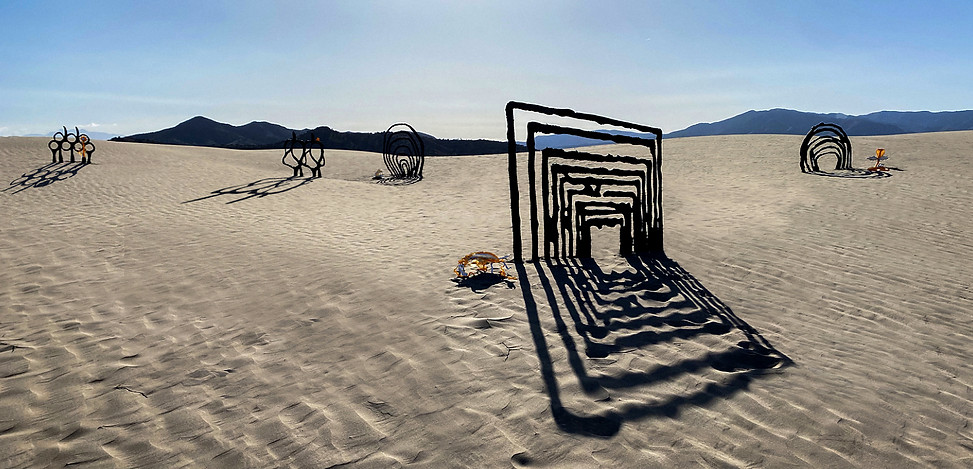
“Each definite thought produces a double effect—a radiating vibration and a floating form.” -Annie Besant & C.W. Leadbeater
Thought-Forms (2022) by artist Andy Ralph is a site-specific installation in the desert of Nephi, Utah. It is supported by the contemporary art gallery Final Hot Desert, a nomadic operation with locations in Salt Lake City, London, and Los Angeles. This installation—created over two years—was carefully discussed, planned, and designed to be viewed solely and indefinitely through its documentation online.
With Thought-Forms, artist Andy Ralph has done more than make a perfect union between objects and landscape. Ralph has made invisible presences, present. Through his intentional thought-form making, he has offered us the chance to see what has always been there. Hidden, but just on the other side.
Thought-forms, as described by clairvoyant theosophists Annie Besant and C.W. Leadbeater, are entities created by thought that exist in the mental or astral plane. In their 1905 book also titled Thought-Forms, Besant and Leadbeater explain that each thought produces a “double effect” or two outcomes that exist intangibly beyond the physical realm as both a "radiating vibration and a floating form.”
In Ralph’s desert sculptures, he offers a physical look at those invisible “double effects.” He materializes his personal thought-forms to be perceived in our world, in our dimension. Five black vibrations bubble up from the desert sand like escaping air. Each one is paired with a floating companionate creature. This installation is one spot of divination within 60,000 acres of sand dunes and flats.
Each black vibration is jagged and crusted—like an expanding breath that has hardened. Pushing up from the heavy sand, the breaths look like they have been practiced—done again and again for relief. Yet, through that repeated breath work, aged. They are matured, perfected, but close to exhaustion.
Later, after I wrote this observation, Ralph shared with me how art-making is a compass for him to navigate life’s hardships. To cope with his younger brother’s hospitalization for a sudden and unexpected traumatic brain injury, he implements anxiety-reducing breath work called the 4-7-8 technique. The patterned breathing supports Ralph’s art practice to not abandon difficulty, but carefully, earnestly, and wearily work through it. In Thought-Forms, Ralph’s breath work shows up formally in the black vibrations. These worn shapes swell up and heave out repeatedly across the desert sand reminding Ralph, and those looking, to keep breathing.
Each hard breath is partnered with a fantastical creature. A two-headed sparrow, tentacled sea urchin, four-clawed crab, winged cobra, and bullfrog embedded with a CD player. Astonishingly, there are no markings in the surrounding sand. It is, instead, entirely rippled by wind. There are no animal (or human) tracks to indicate movement anywhere in this endless terrain. One can only believe that these creatures arrived by floating—just like Besant insisted. Alongside radiating vibrations, she wrote, are flying forms.
These creatures—made of cast latex and cast tin—have also evaded any sand sticking to their skins despite the grabbing force of wind. Latex, for Ralph, is a material that relates to bodies both fictive and real. For imaginative endeavors, latex quickly resembles flesh. Under life-threatening circumstances, it is in the hospital equipment that helps heal bodies—gloves, tubing, syringes, stethoscopes, dressings and bandages. It is a material that holds, heeds, and helps bodies through medical intervention. It is the material that uncomfortably reminds Ralph of the somber and stressful time he spent in hospitals caring for his brother. Latex, for Ralph, triggers harsh memory and dimension-defying possibility.
The cast tin provides physical support to the latex creatures. Despite being metal, the tin retains a look of malleability and regrowth, similar to bones. The tin offers the vulnerable characters, now visible in the hot desert, protection. It helps the tentacled sea urchin cling to its crusted companion while somehow breathing comfortably out of water. It gives wings to the hooded cobra, no longer confined to the ground. And for the crab, it supplies four pinching weapons capable of defending all sides of its otherwise soft yellow body.


For the balloon-sized, latex bullfrog, though, the tin bones stretch its large mouth jarringly open. Is it forced? Forever? Is it to catch whatever may come by? To tempt and trick a lone and greedy passerby? In the open mouth is a blank, burnable CD that is set into a modified CD player. Under the brutal glaring rays, the bullfrog takes the songs of the sun. As the sun revolves around the frog, it records and rerecords the hot star. Because of the tin silver bones, the sun burns not only the bullfrog, but the CD.
According to Besant and Leadbeater, thought-forms last as long as they are energized by collective thought. While most dissipate, those imbedded with sufficient energy can become anchored on the astral plane and to the physical one. Andy Ralph's Thought-Forms has eternal presence.
Help and Harm: Untangling Care from Violence
EXHIBITION REVIEW of Krystal Difronzo's solo show at Bunker Projects
Written by Sidney Mullis
Edited by Anna Mirzayan
Published by Bunker Review
4.20.2022
On view at Bunker Projects, You were born good at make die (2022) is a solo exhibition of fabric wall hangings, silk paintings, charcoal drawings, and dead dough sculptures by Craft Resident Krystal Difronzo. Growing up in the Chicago suburbs, the roots of the exhibition are autobiographical for the artist. To help understand their paternal intergenerational trauma, each artwork grapples with how intimacy, care, and nourishment can occur directly alongside violence.
The exhibition, despite stretching across two white rooms, feels like it’s outdoors. Fabric artworks in shades of muddy brown, earthy green, bone yellow, charcoal black, and cold-night blue cover the walls and front-room windows. However, it is the handmade antlers, bones, and beer cans that tell me I am in a specific backwood: a hunting ground.
Difronzo plucked lyrics from the indie-grunge song “Dead Deer & Other Animals” by the band Thanksgiving to name the exhibition and a majority of the artworks. This song is from Difronzo’s teenage years. They often played it while driving solo on rural, Midwestern roads. The song perfectly soundtracks the exhibition as each line steers me toward dead does, circling vultures, and ruling men.


"No one could pull her off the road" (2022), natural dyes (osage orange, pomegranate and iron) and resist on silk, felt, found fabric, bleach, embroidery floss, ribbon
Fabric wall hangings dangle from hunter orange loops and are sewn together using a variety of secondhand fabrics, RealTree camouflage, and naturally dyed silk. As physical objects, they look as if they could provide the familiar comfort of a blanket, but their imagery depicts death and violence. Animal skulls, dead deer, pecking vultures, flesh-eating coyotes, car crashes, and an altercation between a fictional father and daughter are hand-painted beautifully on soft pieces of silk. This duality of using soft silk to carry imagery of violence and death can be seen repeatedly throughout the exhibition.
Softness carrying the hard, however, is not the only way these two exist in the exhibition. In the front room on opposing walls are a grotto for Artemis and a grotto for Diana—a single deity shown in her Greek and Roman forms. Painted on silk using natural dyes, this deity not only protects wildlife, she kills it. As goddess of the hunt, she is often depicted with a bow flanked by gnashing hounds. Surprisingly, she was even called upon by women to aid in conception and delivery. For Diana/Artemis, the nurturing of wildlife and its termination come from the same hand. Those soft and hard, violent acts coexist within the same entity. A revered deity. Through the making of these artworks, Difronzo processes how protection, in the form of hanging blankets, is stitched together from pain and how the helpful hand, in the form of a beloved goddess, also slaps.
"So come and join the feast" (2022), natural dyes (tea, madder root, turmeric, osage orange pomegranate, and iron) and resist on three silk gauze panels
Difronzo, though, does not let violence and death mark the end of the exhibition. They dig forward to see how the aftermath of a violent act, mournful decay, or death can yield nourishment, growth, and regeneration. So come and join the feast (2022) is a silk painting of a dead deer that becomes food for scavenging vultures. The painting, cut into three panels to cover the front-room windows, casts an end-of-winter blue over the gallery. The dead deer laying limp in overgrown grass looks as if it was beginning to be gutted by its hunter, or goddess, but was stranded. Two vultures attend to its decaying body, its flesh a perfect meal.
Difronzo adores vultures, appreciating them as natural custodians and caregivers. As scavengers, they remove carrion from the cold ground and consume it as nourishment for themselves and for their babies. They use regurgitation to provide food for their young, making every solo meal a family treat. This selfless act of storing food inside one’s self, not to eat, but to deliver can be seen across from the windows in the fabric wall hanging The vultures always want to eat (2022). In the center of the patchwork composition is a hand-painted vulture at its nest, throat full, feeding a baby vulture and a self-portrait of Difronzo. The artist digests how even in death, at the end of things, life is still possible.
In today’s world, it is difficult to separate hunting from the masculine men who partake in the activity. For Difronzo, the film The Deer Hunter (1978) was the only reference they had for Pittsburgh’s landscape and its people prior to beginning their residency at Bunker Projects. This three-hour-and-three-minute movie follows a group of young adult men and their evolving friendship as they experience a wedding, deer hunt, and deployment to the Vietnam war. Most notably for Difronzo, the men only share their affection for one another through violence. Verbal insults, backslaps, bullying, finger-numbing handshakes, and constant roughhousing is the manner in which their intimacy is made visible or even offered. In nearly every scene. Almost every line.
Difronzo pulled four landscape images of Pittsburgh from the film and rendered each in charcoal on pomegranate-dyed paper. While the men and their quasi-closeness is absent from the drawings, their identical titles, One Shot (2022), shove the ultra-masculine energy back into every wooden frame. This title comes from Robert De Niro’s character, Mike, who declares that a hunter must take down a deer with only “one shot.” Any more is a failure — a failure of manhood, of course, not hunting.
Difronzo completes the exhibition with the most beguiling sculptures of bones, hooves, antlers, and Hamm’s beer cans — all made of dead dough. Dead dough, sometimes called salt dough, is deceivingly non-edible bread. The dough is considered dead because there is no yeast to metabolize the starches and sugars in the flour. Instead, the flour and water is overtaken by heaps of salt. Kept from developing its nutrients, the dead dough does not rise, but dries out in a low-degree oven. Prior to becoming essentially preserved, the dough is shaped with a razor, much like a baker scours the top of bread, and is coated with egg white to add that warm color to the hard crust. Regardless, these bread sculptures cannot offer any sustenance, even if they are in the shape of bones with deeply held marrow. And, those beer cans — Difronzo has emptied those, too. These sculptures make me reconsider what provides nourishment and what, despite appearances, does not.

"Marrow Altar" (2022), dead dough, local grasses and thistles
By surveying music alongside film, mythology, nature, food, and science, Difronzo draws a complex map to help untangle an emotional past. Their exhibition exposes how opposing dualities can become—complicatedly—one and the same. Soft and hard, feminine and masculine, care and violence, nourishment and decay, birth and death. The collapse of some of these seemingly contrasting attributes, like feminine and masculine, is beautiful and category-defying in ways the 21st century desperately needs. The collapse of care into violence, though, has always been and always will be dangerous, traumatic, and potentially fatal.
Reverie Pink
EXHIBITION REVIEW of Lacey Hall's solo show at Bunker Projects
Written by Sidney Mullis
Edited by Anna Mirzayan
Published by Bunker Review
8.27.2021
The Interior Castle (2021) is a sweet and gentle exhibition of small paintings, drawings, and sculptures by NYC-based, Pittsburgh-grown artist Lacey Hall. The exhibition, stretching across two rooms, is hung in a loose gallery midline except for one hidden object that waits to be found. The work is personal in size with the smallest oil painting measuring 2-by-2 inches and the largest watercolors at 11-by-14. The paintings look like they could nestle into the palm of your hands and the watercolors feel like the book illustrations you poured over as a kid (instead of reading the boring three-word-sentence on the next page).
Spread across Bunker’s fireplace mantel are toy-sized clay objects that tempt you with play. A Barbie-sized horse, crown fit for a fig, and teeny-tiny lamb sit perched, waiting and willing. Painted calamine-pink, their rosy coats magnify the existing soothing quality of playtime and playthings. Their color is seen again—large-scale and enveloping—in the second room of the exhibition that has been painted the same balmy color.


The Interior Castle installation view at Bunker Projects, 2021
Working in ink, watercolor, gouache, acrylic, and oil, Hall shares moments of romantic escape. Her two-dimensional works reveal scenes of girls, teenagers and princesses isolated and unbothered in idyllic open fields, green forests, cool fountains, and sacred childhood bedrooms. The environments provide the young women with reprieve, or at least a moment of quiet transition. The surroundings sometimes shift into surreal terrain—as seen in Desert Race (2020), Runaway (2021), and Time will turn/the world will turn (2021)—where incongruous scale and opposing perspective live side-by-side. Yet, the young women are still unbothered. They are cozy—comforted by the absence of exterior logic.
In Hall’s Pinctada (2021), for example, a young woman donning a pink dress with glorious puff sleeves is putting on her classy red heels despite clearly living underwater in an oversized, pearl-producing oyster. Breathing underwater? That is not a problem in this interior castle. The clear comfort of these spaces is made certain by the companion animals usually standing near the solitary young women. While they may be isolated—faraway from other places and people—the animals prove they are not alone. Their partnership seems vital for the possibility of reverie in these scenes.
Horses, cats, and dogs—as seen in Desert Race (2020), Unsettling dream in a minidress (2020), Creamsicle (2020), Time will turn/the world will turn (2021), It’s not like I’m Invisible (2021), and Runaway (2021)—have anciently long and rich histories in painting. Their presence here is primarily one of close friendship—hardened by the grieving of dog death found in two artworks. In Time will turn/the world will turn (2021)—the only black ink drawing in the show—a flying angel whisks across the sky holding a dog. She ushers it lovingly forward by a large sash wrapped around its belly. On the ground is a canopy structure built entirely of bones marked with the blowing flag “Beloved Dog.” This terrestrial grave marker protects a dog-sized mound of bones—the same ones that the structure is made of.
The next lamentation of dog death is both harder to find and more emphatically announced. Missing my dog (2020) is a 3.5-by-2-by-2 inch vessel hidden in the exposed brick wall in the pink room of the exhibition. Like a secret urn holding the ashes of a loved one, this painted clay object is nestled above the baseboard molding and below the wall outlet. These few inches of overlooked space are the perfect height for the sniffing snout of a mid-sized dog—which matches the size of the yellow Labrador painted on the vessel.
Hall’s brushstrokes emerge as quick and expressive, yet are detailed without forced rigidity. She employs a vast visual vocabulary that is both invented and sourced—including reference to Horace Pippin’s lamb, shells, shoes, stars, swans, flowers, deer, birds, fruit, purses, vanities, candles and more. These moving symbols produce a network of meaning and relationships between the work. For instance, a desirable and prominently placed blue glass chalice in Tabletop Theatre (2018) is found again—now modestly—on a small table in the corner of Bedtime by the River (occupied Osage Territory) (2021). A bunny on the loose in They got all dressed up (2021) seems to have broken out of its corral in Time will turn/the world will turn (2021). The physical position needed to view Hall’s works is close, and the emotional temperament near intimate.
The two most contemporary and clearly beloved paintings of the exhibition are of white cotton towels that have been folded into swans. Known in the hospitality industry as “towel swans,” they can be found on hotel beds or cruise ships. Measuring less than 5-inches, each painted towel swan is centered in the composition and rendered absurdly small with remarkable care, making the soulmate symbolism evermore present and sentimental. The hands that made these tender cotton twists are still in sight, supporting the necking heads—hinting that the maker is not a hotel employee, but a lover. Here, romance materializes from the repeated roll-and-fold of a towel.


Isabella's Swan, 2021 Dinner for Two, 2021
In adulthood, sweetness (or softness, or gentleness, or quietness) is often overlooked for its perceived ease and vapidity. As a child, it is coddled and protected. In adolescence, it can make you a target or invisible flower. As a woman, it deems you desirable, profitable. This sweet syrup overflows in childhood and hardens with age. For Hall, the ease with which she sources, renders, and re-envisions sweetness in her work proves that it has been her longtime refuge; one that appears to have never been lost, ignored, or used against her, and one that she continues to fortify—as seen in her exhibition The Interior Castle (2021)—to build her own everyday romantic escape.
Letters to My Students
One letter to my students in Beginning Sculpture & one letter to my students in Advanced Contemporary Art Seminar called The Shape of Space
At the end of Spring 2020, we were still enduring the Covid-19 global pandemic. I was teaching two courses, Beginning Sculpture and an Advanced Art Seminar called The Shape of Space, online via Zoom to keep our communities safe from contracting coronavirus. As the end of the academic semester drew near, I became preoccupied with how to conclude my courses in a meaningful way. How do you say goodbye to groups of students during a global pandemic? How do you say goodbye that isn't just an awkward Zoom wave and the closing of my web browser? How do you say goodbye to students that continued to foreground their education despite a time of consistent uncertainty, political chaos, lethal racism, rising unemployment—bracketed by the fear of getting sick? I decided to write them letters which I read over Zoom at the end of each class. They are frank, vulnerable, somewhat circuitous, and a little inspiring.


Foundation (2014)
The words in this book of poems were appropriated from Youtube videos of young girls providing makeup tutorials.
12 Youtube videos were selected and carefully transcribed to include every "uhm" and "uh." Videos were chosen based on their titles and had to indicate a grade or age that the look was intended for, such as "natural 4th grade makeup." The girls providing these tutorials ranged from age five to age twelve and their videos were uploaded between 2012 to 2014.
The process of transcription was done manually. I listened to the videos again and again—playing, pausing, typing, rewinding, playing—in order to get an accurate transcription. It was tedious, intimate, heartbreaking, and familiar because I was also one of those girls who made makeup tutorials, but for the silence of my bedroom, not anonymous Youtube viewers.
After transcription, the language was divided according to makeup product and restructured into poems. Foundation, Eye Shadow, Blush, Mascara, Lip Gloss. In addition to makeup application instructions, there are many mentions for the makeup to be "natural" and for the desire to be confident. There are multiple reminders about how a little makeup goes a long way and to be sure not to do too much makeup because they're just kids.


